

When it comes to improving sedimentation efficiency in water and wastewater treatment, tube settlers play a critical role. These compact yet powerful systems optimize the clarification process by increasing the effective settling area within a treatment basin, helping facilities achieve cleaner effluent in less time and with less space.
What Are Tube Settlers?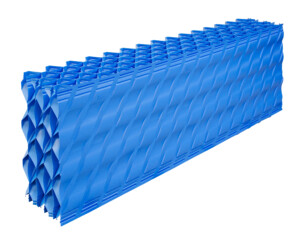
Tube settlers are modular systems engineered to optimize sedimentation in clarifiers and settling tanks. Featuring multiple adjacent tubes inclined at a 60° angle, they dramatically increase settling surface area, allowing solids to separate more efficiently from the water column. These individual channels promote uniform flow and consistent particle settling, maximizing performance and clarifier capacity in a compact footprint.
How Do Tube Settlers Work?
As influent flows upward through the tube settler’s inclined channels, suspended particles separate from the water column under laminar flow conditions, settle onto the tube surfaces, and are conveyed downward along the channel walls by gravitational force to the basin floor. This video demonstrates the settling process occurring inside a channel:
Here’s how this process enhances clarification:
Increased surface area: The angled tube design multiplies the available settling surface area without expanding the basin’s footprint. This allows particles to settle more quickly than in conventional clarifiers.
Shortened settling distance: Since each channel acts as a mini-settling zone, the distance particles must travel before settling is significantly reduced. This improves the rate at which solids separate from liquid.
Particle coalescence: Smaller suspended particles collide and combine as they pass through the tube channels, forming larger, heavier flocs that settle more easily.
Uniform flow distribution: Tube settler design helps maintain consistent, laminar water flow. This minimizes turbulence and prevents re-suspension of settled solids.
Applications of Tube Settlers
Tube settlers are used across a wide range of treatment applications. Their modular design allows for straightforward installation in both new and existing sedimentation tanks, making them a versatile upgrade option. Some common applications include:
Municipal drinking water plants to improve sedimentation in primary clarifiers.
Wastewater treatment plants to remove suspended solids before biological treatment or filtration.
Industrial water systems, such as in mining, food processing, and chemical manufacturing, where efficient solid-liquid separation is vital.
Advantages of Tube Settlers
Tube settlers offer numerous operational and design benefits:
High efficiency in a compact space: They can increase settling capacity several times over without expanding tank size. Tube settlers are highly customizable and can accommodate a range of basin configurations.
Lightweight and easy to install: Tube settlers are durable, portable, and adaptable to various tank configurations. Modules don’t require heavy lifting equipment to install.
Cost-effective: Tube settlers inherently have a low capital cost due to materials of construction. By improving sedimentation efficiency, they reduce the load on downstream processes and can lower energy and maintenance costs for plants, as well.
Improved water quality: Enhanced settling leads to clearer water and reduced turbidity, improving overall treatment performance.
The Role of Tube Settlers
In water and wastewater treatment plants, tube settlers are a valuable tool for improving process performance. Their ability to improve sedimentation efficiency, reduce clarifier footprints, and enhance effluent quality makes them a smart, sustainable choice for facilities looking to do more with existing assets.
Brentwood offers tube settler solutions designed to support a range of sedimentation applications. Our IFR-6000 Series and TUBEdek® systems provide multiple design options to accommodate both new installations and retrofit projects, with additional system details available on each product page.

 English
 Español
 简体中文
简体中文 हिन्दी
 ไทย
ไทย