

To achieve consistent, high-performance treatment from a trickling filter, it is not enough to focus on the trickling filter alone. Trickling filters are biological systems that depend on stable hydraulics, proper loading, and effective solids separation both upstream and downstream.
Understanding the complete path from influent to effluent ensures the filter operates within design parameters and delivers reliable biochemical oxygen demand (BOD) and ammonia reduction. Let’s take a closer look at the various systems commonly used in wastewater treatment to examine how each step directly impacts trickling filter performance.
Upstream Equipment
Trickling filters are known for their resilience to hydraulic and organic shock loading. However, factors like extreme fluctuations, debris, or excessive fats, oils, and grease (FOG) can still impair oxygen transfer and biofilm performance. Proper upstream processes help maintain stable operating conditions and protect long-term filter efficiency.
Screens
Screening prevents large solids from entering the system and damaging pumps, plugging distributors, or accumulating within the media. A 6 mm (1/4 inch) directional screen is typically recommended to protect downstream equipment.
Grit Removal
Grit removal helps maintain trickling filter performance by removing abrasive inorganic materials, such as sand and small stones, from the influent. Without effective grit removal, these materials can accumulate in pumps, distribution systems, and underdrain areas, increasing wear and maintenance requirements. Proper grit management reduces mechanical strain and prevents unnecessary buildup within the trickling filter structure.
Balance Tanks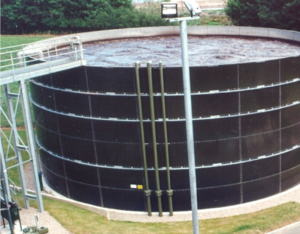
For industrial applications where flows and loads can fluctuate significantly, a balance tank can be used to equalize hydraulic and organic loading, providing steady state conditions that protect the trickling filter’s biofilm from shock loading.
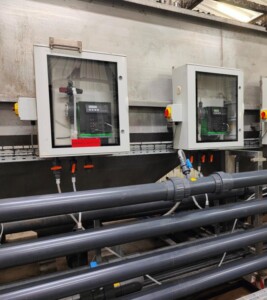
pH & Nutrient Dosing
Biological treatment performs best at a near-neutral pH, typically between 6 and 8. Where nutrient deficiency exists, supplementation may be required to maintain an efficient working biomass. A typical nutrient ratio is 100:5:1 (BOD: NH3-N:PO4-P).
FOG Interception
High levels of fats, oils, and grease can coat media surfaces and restrict oxygen transfer. In industrial applications where high levels of FOG are present, it may be necessary to include a form of upstream FOG interception. Common solutions include grease traps or dissolved air flotation (DAF) systems, both designed to reduce FOG concentrations before wastewater reaches the trickling filter.
We recommend maintaining a level of FOG below 100 mg/L to ensure the trickling filter remains clean and free from blockages.
Primary Settlement
Primary clarification should be used to reduce suspended solids and provide initial chemical oxygen demand (COD) and BOD reduction, which is typically between 25%-30%. This reduces organic loading on the filter and improves overall stability. A common example of primary clarification is a chain and flight sludge collector, like our Polychem® systems.
Feed Pumps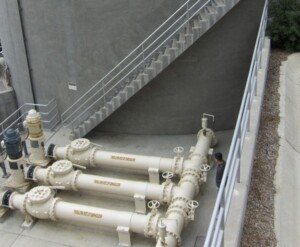
Following primary settlement, feed pumps may be required to lift wastewater to the trickling filter’s distribution system. Feed pumps are usually set up in a duty/standby configuration to ensure continuous operation.
Downstream Equipment
After wastewater passes through the trickling filter, biomass sloughs from the media and must be separated from the treated effluent.
Secondary Settlement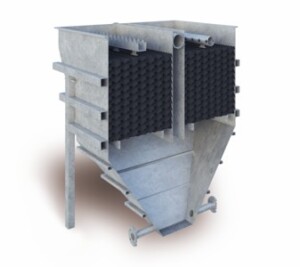
Trickling filters convert soluble BOD into insoluble BOD. Secondary clarification separates this biomass from the treated water. Clarifier design must accommodate hydraulic peaks and variable solids loading from sloughing events.
Another option for secondary settlement is to use a lamella tube settler within the tank. Tube settlers enhance clarifier performance by increasing effective settling area. Tube settlers enable higher flow rates within a smaller footprint, making it ideal for retrofits, space-limited sites, or facilities with seasonal peak flows. In industrial applications with lower flow rates, it’s also possible to use a standalone settlement tank in series or parallel to handle seasonal increased flows.
Recycle Pumps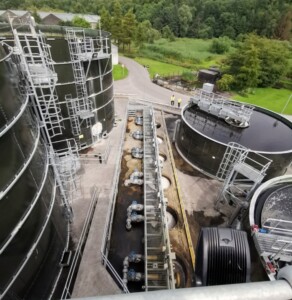
It is important that plastic media is kept wetted on a continuous basis to maintain an efficient working biomass. To ensure the minimum wetting rate (MWR) is achieved, the wastewater should be recycled to make up the difference between the feed flow and the MWR. Recycling also moderates organic loading and supports nitrification in high-rate systems.
Taking a System-Level Approach
Trickling filters are durable and adaptable biological systems, but their efficiency is influenced by both the surrounding treatment processes and the integration of their own internal components. While upstream and downstream equipment plays a significant role in overall performance, trickling filters also require proper coordination between tank configuration, media selection, support systems, and distribution to maintain hydraulic efficiency, oxygen transfer, and long-term reliability.
When all of these elements function together as a unified system, trickling filters can deliver consistent performance with lower energy requirements and reduced operational complexity compared to many suspended growth processes. For a deeper discussion on how upstream and downstream processes integrate with trickling filter design, watch our More Than Media: Supplementary Components and Processes webinar and explore our blog for additional insights on trickling filter system components.

 English
 Español
 简体中文
简体中文 हिन्दी
 ไทย
ไทย