

February 12, 2026
Product Line: Water & Wastewater.
Product Line: Water & Wastewater.
Food and beverage manufacturing accounts for around 92% of global water consumption and produces more wastewater than any other industry. The food and beverage industry encompasses a complex and diverse network of product sectors, subsectors, processes, and activities including:
- Primary production of raw food via farming and fishing
- Primary processing of raw foods into saleable products and ingredients
- Secondary processing of raw foodstuffs (ingredients) into other forms such as edible oils, flout, and dairy products
- Ultra-processing: combining already processed ingredients to create a new food item, like jam, fruit, squash, instant coffee, and ready meals
The Challenge of Treating Food Industry Wastewater
Wastewater from food production is notoriously difficult and expensive to treat due to high biochemical oxygen demand (BOD) and chemical oxygen demand (COD) and large quantities of nutrients, organic carbon, nitrogenous compounds, inorganics, and suspended or dissolved solids.
Because this wastewater is a major source of environmental pollution, the industry is under growing pressure to reduce energy usage, carbon emissions, and pollutant discharge. However, the wide range of processes and products involved makes finding the most effective biological treatment system a complex challenge.
How Trickling Filter Technology Helps
Trickling filter systems are a proven, sustainable solution that help food and beverage manufacturers enhance treatment performance while lowering operational costs. These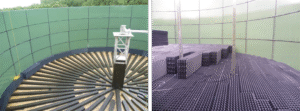 systems deliver reliable results even under the most demanding conditions by:
Improving treatment capacity and quality
Effectively treating wastewater with high BOD/COD loads
Reducing operational energy demand
Lowering carbon footprint
Ensuring consistent effluent quality
Providing long-term reliability and durability
By integrating trickling filter technology, facilities can achieve compliance with evolving regulations while supporting sustainability goals and minimizing energy-intensive treatment processes.
Design Considerations
- Treatability:
Food and beverage wastewater has a wide range of treatability’s which need to be considered when sizing any biological treatment plant. A first step is to look into the wastewater COD and BOD ratio. The smaller the ratio the more treatable the wastewater. To be certain of the treatability, a piolet study should take place. - Influent COD and BOD concentrations:
Systems with plastic media can treat COD concentrations up to 10,000 mg/L and BOD concentrations up to 5,000 mg/L. Low surface area media (100-125 m2/m3) with large apertures and vertical flow design are essential at these high concentrations to avoid blocking with excess biomass. - Variable infeed flows:
Food and beverage companies often have variable infeed flows through a given day or if they don’t operate at the weekends. Consequently, a balance tank should be considered to provide a steady infeed flow and/or a recycle system. - Nutrients:
Unlike municipal wastewater, food and beverage wastewater may not naturally contain the required nutrients to sustain an efficient working biomass. Therefore, nutrient dosing may be required before passing into the trickling filter. - pH adjustments:
pH is often outside the desirable neutral range of 6-8. Therefore, some form of pH should be incorporated. - Fats, oils, and greases (FOG):
Many food wastewaters will contain fats, oils, and greases. These should be intercepted before entering the trickling filter and limited to a maximum concentration of 60 mg/L.
Four Signs It’s Time to Upgrade Your Wastewater System
Tighter effluent standards:
As stricter regulations come into force, will your system meet compliance levels? Non-compliance risks costly fines and legal action.Aging equipment:
Older systems often carry hidden costs — including increased maintenance, downtime, and inconsistent process outcomes — compared to more efficient modern technologies.Energy inefficiency:
Advances in treatment technology now make it possible to lower energy use and reduce carbon emissions, delivering measurable ROI and improved sustainability performance.Production changes:
Any planned increase or modification in production volume or product type can put additional pressure on your existing effluent treatment system. Factoring these changes into your process design is essential to maintain compliance and performance.
Want to learn more? Watch our Trickling Filters for Food and Beverage Wastewater Treatments webinar. Additionally, check out our Learning Center page for our comprehensive eight-part Trickling Filters for the 21st Century webinar series.

 English
 Español
 简体中文
简体中文 हिन्दी
 ไทย
ไทย