

A common misconception regarding trickling filters is their inability to consistently nitrify to low ammonia effluents. This misconception has persisted despite well-established examples of trickling filters nitrifying in all climates. Given the history of trickling filters providing consistent nitrification, it is useful to highlight specific examples of trickling filter plants used for nitrification and their operational history.
Carrollton, KY
The Carrollton Wastewater Treatment Plant is located in northern Kentucky and operates in a four-season climate. The plant’s treatment process consists of influent screening, aerated lagoons for biochemical oxygen demand (BOD) removal, nitrifying trickling filters (NTFs), secondary clarification, and UV disinfection. Cascade aeration is used before discharge into the Kentucky River. The NTFs were installed in 2005 and are both 52 ft in diameter with a 28 ft media depth. The towers operate in parallel with each receiving 50% of the flow. Each tower consists of Brentwood’s CF1900 cross flow trickling filter media. The media is installed atop Brentwood’s AccuPier support system.
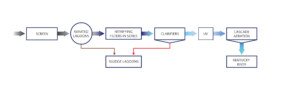
During the 2020–2022 period, the facility operated at an average daily flow of 1.48 MGD. Throughout the operating life of the NTFs, the plant has consistently met permit requirements, with average effluent concentrations of 2.15 mg/L cBOD and 1.81 mg/L ammonia over the period reported. Operation and maintenance of the filters have remained straightforward, with no major repairs or retrofits required.
| Carrollton WWTP Flow Rates (MGD) | |
|---|---|
| Average Daily Flow | 1.7 |
| Average Daily Flow, 2020-2022 | 1.48 |
| Maximum Monthly Average Daily Flow | 2.2 |
| Peak Daily Flow | 4.6 |
| Peak Hourly Flow | 5.8 |
The distributor arms feature a fixed-speed design, and the media is nearing the upper end of its typical 20–25-year service life. Despite these factors, the filters continue to perform at a high level without upgrades, suggesting additional capacity for increased loading and potential further improvements in ammonia removal.
Conclusion
The Carrollton plant demonstrates year-round nitrification in a cold climate, even with media approaching the end of its design life. Despite this, the plant continues to achieve reliable BOD and ammonia treatment. This plant is a great testament to the capacity and resilience of NTFs under proper operation by a dedicated staff and demonstrates the viability of NTFs as a dependable biological treatment solution across a wide range of climatic conditions.

 English
 Español
 简体中文
简体中文 हिन्दी
 ไทย
ไทย